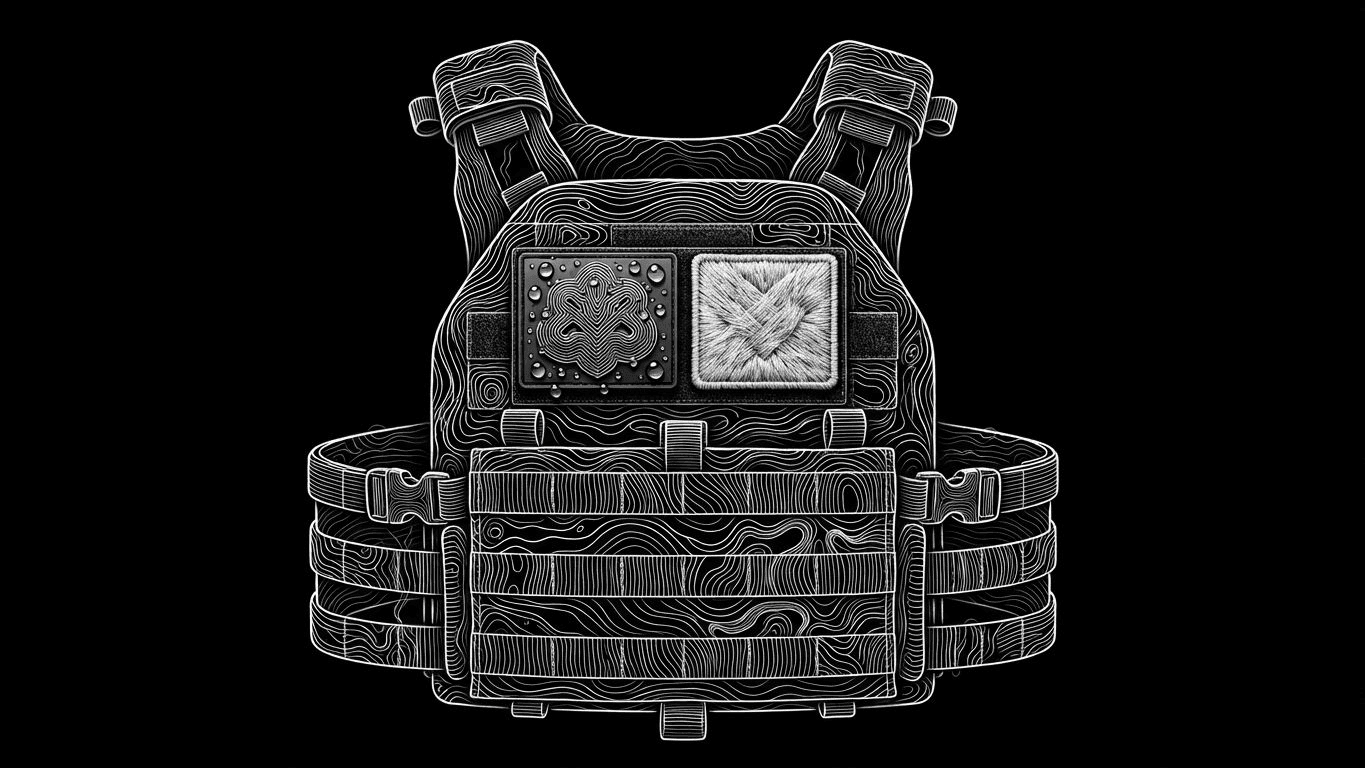
PVC patches vs embroidered patches for tactical use
PVC Patches vs Embroidered Patches for Tactical Use
When selecting patches for tactical applications, the choice between PVC and embroidered construction carries real operational consequences. Both formats have earned their place on uniforms, gear, and kit, but they perform differently under field conditions, wash cycles, and visual scrutiny. This guide examines the core differences across durability, design capability, cost, and practical suitability to help units, teams, and organisations make an informed decision.
What Distinguishes PVC Patches from Embroidered Patches
Embroidered patches are constructed from polyester or cotton thread stitched onto a woven base fabric. The texture is raised and tactile, with colour achieved through thread selection rather than dye or printing. PVC patches, by contrast, are moulded from soft rubber or polyvinyl chloride compounds, with colour and detail built directly into the mould during production. The result is a firm, flexible patch with crisp edges and a slightly glossy finish.
Each construction method reflects a different set of priorities. Embroidered patches carry a heritage association with military and uniformed service; they communicate tradition, rank, and institutional identity through a familiar visual language. PVC patches emerged more recently as a tactical format, favoured for their resilience and the precision with which they can render complex insignia, unit crests, and morale designs.
Durability Under Tactical Conditions
Durability is the primary consideration for tactical use, and the two formats differ substantially in how they age under field stress.
According to chieflabels.com, a properly formulated PVC military patch can survive 50 or more industrial wash cycles without edge curl, colour shift, or dimensional change. The same source reports that embroidered patches with merrowed borders at 10 stitches per inch can survive 40 or more commercial wash cycles without fraying, provided they meet the recommended minimum density of 8,000 stitches per 10 cm² for crest-sized tactical patches.
The gap widens when embroidery density falls below that threshold. chieflabels.com notes that at an economy embroidery density of 5,500 stitches, the reject rate rises to 20 to 25 percent by cycle 20 to 25. This makes specification quality a critical variable when ordering embroidered patches for high-rotation tactical use.
For outdoor exposure specifically, pacificemblem.com confirms that PVC performs with clear advantage in pure outdoor conditions, with rain, mud, and UV exposure having no meaningful effect on the material. Embroidered patches handle outdoor use well on garments but are more vulnerable to prolonged moisture saturation and abrasion in demanding field environments.
According to patchesjunction.com, embroidered patches last 5 to 10 years with daily commercial washing, while PVC outlasts everything else in harsh outdoor conditions. For units that rotate gear frequently or operate in wet, high-abrasion environments, PVC offers a measurable longevity advantage.
WASH LONGEVITY COMPARISON
══════════════════════════════
PVC (50+):         [██████████]
Embroidered (40+): [████████  ]
══════════════════════════════
Wash cycle longevity: PVC vs. Embroidered.
Design Capability and Visual Precision
The two formats serve different design requirements, and understanding those differences prevents costly specification errors.
Embroidered patches excel at:
- Bold, high-contrast designs with defined colour blocks
- Traditional insignia with a classic, textured appearance
- Designs where the handcrafted aesthetic is part of the identity
PVC patches excel at:
- Fine detail, small text, and intricate line work
- Gradient effects and dimensional depth through 3D moulding
- Designs requiring exact colour matching across large quantities
PVC moulding allows for both 2D flat designs and 3D raised relief, which gives unit crests and morale patches a sculptural quality that embroidery cannot replicate. For tactical patches where a unit's insignia includes fine linework or small lettering, PVC is generally the more reliable format.
Embroidered patches, however, carry a visual weight and texture that many uniformed organisations prefer for formal identification purposes. The layered thread construction gives them a depth and warmth that PVC does not reproduce.
Cost Comparison
Cost is a practical factor for any procurement decision, particularly for units ordering in volume.
According to betteremblem.com, specialty patches such as PVC or leather typically cost 20 to 50 percent more than standard embroidered patches, due to the unique materials and moulding processes involved.
At Patch&Bagel, this pricing difference is reflected clearly in the catalogue. Custom embroidered patches start at SGD 160 for 20 pieces (SGD 8 per patch), with prices falling to SGD 5 per patch at 100 pieces and SGD 3 per patch at 300 pieces. Custom PVC patches start at SGD 300 for 30 pieces (SGD 10 per patch), with prices falling to SGD 7 per patch at 100 pieces and SGD 4 per patch at 500 pieces.
For large-volume orders, the per-unit cost difference narrows considerably, which makes PVC more competitive at scale. For smaller runs where budget is constrained, embroidered patches offer a lower entry point with a minimum order of 20 pieces compared to PVC's minimum of 30.
Comparison at a Glance
| Factor | PVC Patches | Embroidered Patches |
|---|---|---|
| Wash cycle resistance | 50+ industrial cycles | 40+ cycles (at 10 stitches/inch) |
| Outdoor/UV resistance | Excellent | Good |
| Fine detail capability | High | Moderate |
| 3D relief option | Yes | No |
| Traditional appearance | No | Yes |
| Entry price (Patch&Bagel) | SGD 10/pc at 30 pcs | SGD 8/pc at 20 pcs |
| MOQ (Patch&Bagel) | 30 pieces | 20 pieces |
Which Format Is Right for Tactical Use
The answer depends on the specific application.
Choose PVC patches when: the gear will face sustained outdoor exposure, frequent washing, or high-abrasion conditions; when the design includes fine detail or small text; when 3D moulding adds value to the insignia; or when long-term dimensional stability is a priority.
Choose embroidered patches when: the application calls for a traditional, textile-based appearance consistent with formal uniform standards; when the design uses broad colour blocks rather than fine linework; when budget per unit is a primary constraint; or when the patch will be worn on garments in moderate-use environments.
For morale patches, unit crests, and gear identification used in field conditions, PVC is increasingly the format of choice among tactical users. For formal dress uniforms, rank insignia, and institutional identification, embroidered patches remain the standard.
┌────────────┐          ┌───────────┐
│ FIELD USE? │───YES───▶│ PVC PATCH │
└─────┬──────┘          └───────────┘
      │ NO
      ▼
┌────────────────┐      ┌────────────┐
│ DRESS UNIFORM? │─YES─▶│ EMBROIDERY │
└────────────────┘      └────────────┘
Patch selection logic based on application.
Frequently Asked Questions
Are PVC patches approved for military uniform use? Approval depends on the specific service branch and uniform regulations. PVC morale patches are widely used on tactical gear, plate carriers, and field kit. Formal dress uniform patches are typically embroidered. Units should verify with their own uniform standards before ordering.
Can PVC patches be attached with Velcro? Yes. PVC patches can be produced with hook-and-loop (Velcro) backing, which is the standard attachment method for tactical gear. Patch&Bagel produces custom PVC patches with Velcro backing as a standard option.
Do embroidered patches fade in the field? High-quality embroidered patches using polyester thread with a minimum tensile strength of 4.0 N per strand, as specified by chieflabels.com, resist fading well. Lower-quality thread and insufficient stitch density accelerate degradation, which is why specification quality matters significantly.
What is the minimum order for PVC patches at Patch&Bagel? Patch&Bagel's custom PVC patches have a minimum order of 30 pieces per design, starting at SGD 300 total. Every order includes a free digital proof before production begins.
How long does production take? Patch&Bagel's standard production turnaround for custom patches is approximately 14 to 20 days, with free international shipping included.
If you are ready to order, Patch&Bagel's Custom PVC Patches are fully waterproof, UV-resistant, and available in 2D or 3D moulding from 30 pieces, making them a strong choice for tactical and field applications. For units that prefer the traditional textile aesthetic, Custom Embroidered Patches are available from 20 pieces with a free digital proof and free design help included on every order.
Explore more from Patch&Bagel at Patch&Bagel
┌────────────────────────────────────────┐
│             PATCH & BAGEL              │
│      Tactical-Grade Customization      │
└────────────────────────────────────────┘
PATCH & BAGEL | Tactical-Grade Customization